An update on Culbaba Theatre’s reconstruction project, November 2026
By Olena Zdielnikova, Artistic Director, Culbaba Theatre CIO
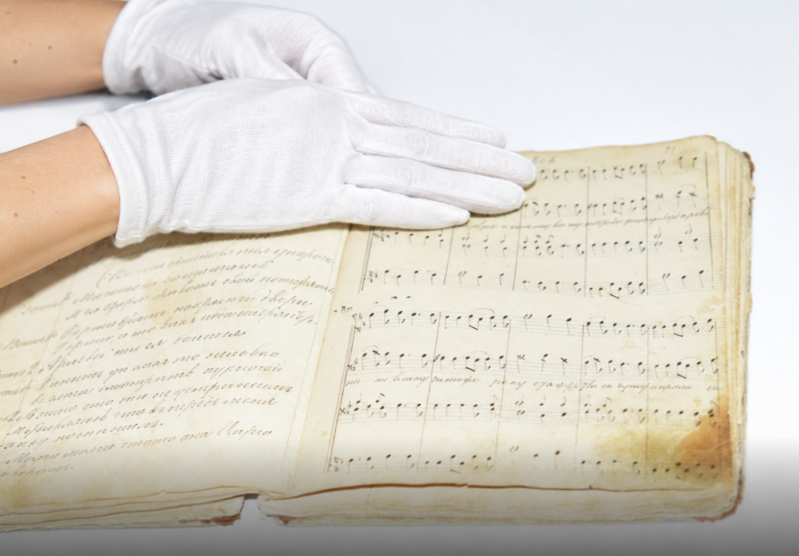
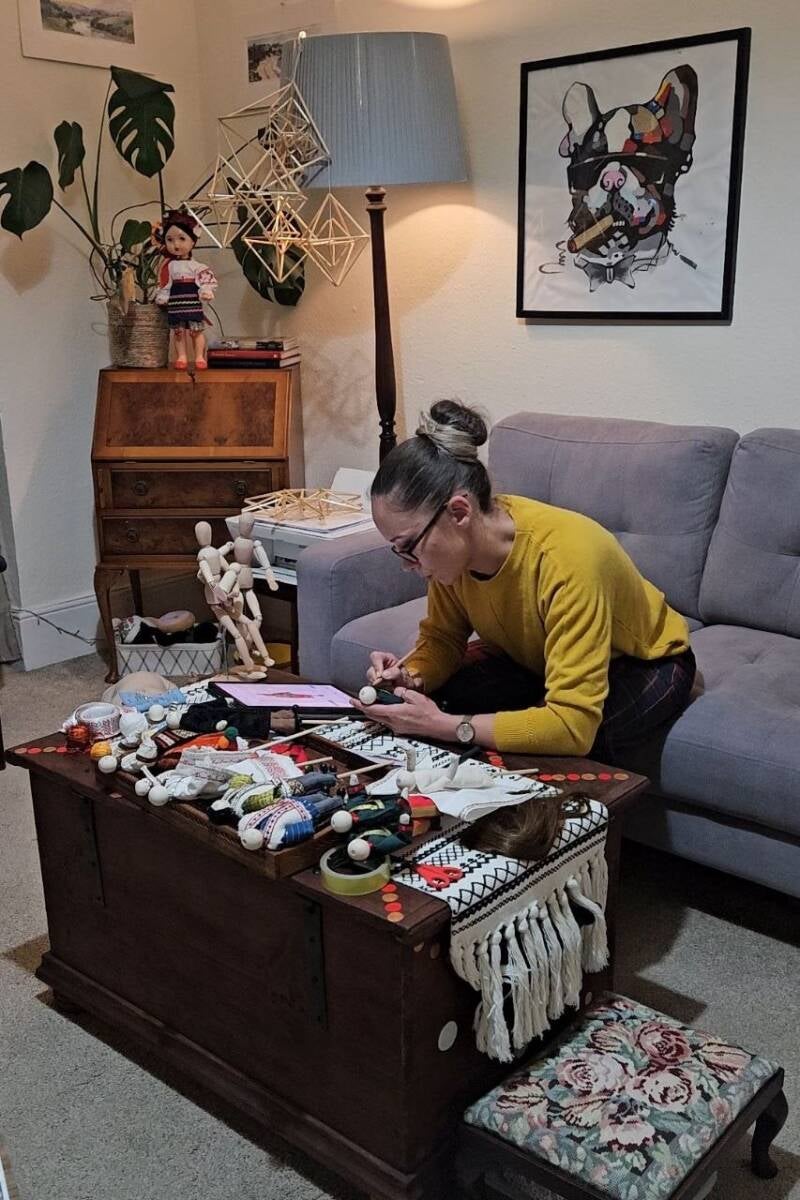
"When I began working on the reconstruction of the Sokyryntsi Vertep, the first and most important question was what, exactly, I was trying to reconstruct. As a musician and someone who has spent a considerable part of my life on stage, I wanted to preserve the original music, the character of the historical language and, as far as possible, the way the performance might have sounded." The theatre is traditionally dated to 1770, and unlike many other examples of Ukrainian puppet theatre from that period, it has left behind an extensive collection of evidence: a wooden theatre chest, surviving puppets, dramatic texts, musical notation and historical descriptions. At first glance, this might seem to make the task relatively straightforward. In practice, the deeper I went into the material, the further down the rabbit hole I found myself. Even a carefully preserved script and musical score cannot tell us everything about how a performance actually worked, especially when it comes to the mechanics of the theatre and the movement of its characters.
The Sokyryntsi Vertep takes its name from the Halahan family estate in the village of Sokyryntsi, where, according to the family account published by Hryhorii Halahan in 1882, a group of students from the Kyiv-Mohyla Academy performed a Christmas puppet play in 1770. The theatre subsequently remained in the family's possession, and the surviving collection is now held by the Museum of Theatre, Music and Cinema Arts of Ukraine in Kyiv. The original eighteenth-century manuscript has not survived, although a later copy preserves the dramatic and musical material. Together with nineteenth-century publications and subsequent research, these sources give us an unusually detailed picture of Ukrainian theatrical and musical culture. This is precisely what makes the idea of performing the Sokyryntsi Vertep today so appealing.
The reconstruction is taking place in Bexhill-on-Sea, East Sussex, which brings an obvious practical difficulty: the original objects are in Ukraine, and I cannot examine them directly. The Museum of Theatre, Music and Cinema Arts of Ukraine has been generous in supporting the project, providing photographs, technical descriptions and other documentary materials that have made it possible to study the surviving theatre and puppets in greater detail. I have supplemented these with historical publications, museum catalogues, musicological research and visual sources from the period. Nevertheless, photographs and written descriptions cannot answer every question that might arise when examining an object in person, especially when its construction and movement are as important as its appearance.
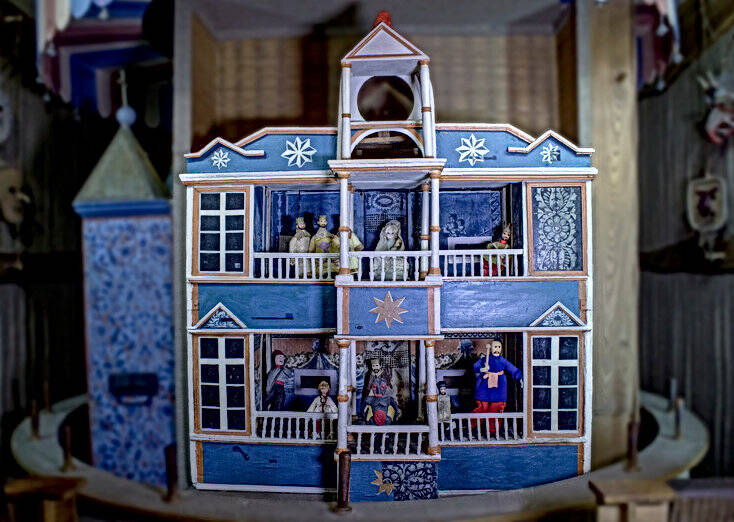
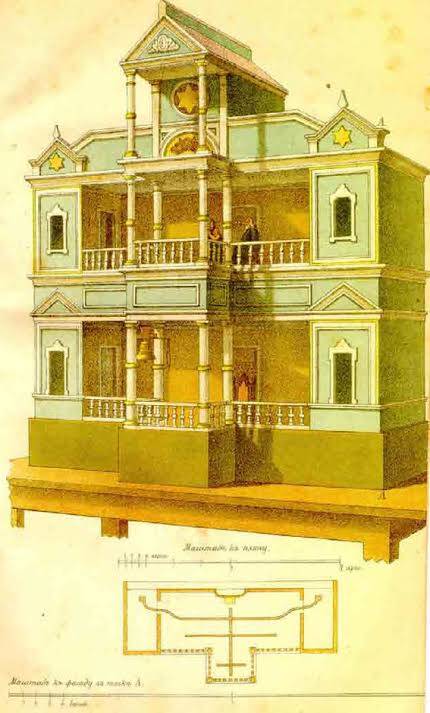
Comparing the theatre chest preserved in the museum with Halahan's description and illustration brings us to the first puzzle. They look similar enough to be recognisably the same theatre, yet there are differences in both their construction and decoration. The chest is a working theatrical mechanism, determining how the puppets move, enter and disappear, and how the action unfolds across its two levels. The surviving technical documentation includes measurements and descriptions of the internal structure and puppet tracks, but it is clear that the theatre changed during its long history. As Markevych himself noted, we do not know what principles guided the artist who prepared the illustration for Halahan's article, or even who that artist was. Whoever it was, though, they certainly made an effort.
The museum photographs offer further clues. The Vertep remained in the Halahan family for almost a century, and performing it at Christmas became a family tradition. The chest was evidently looked after and redecorated over the years, and several layers of paint can still be seen, sometimes covering earlier patterns and decorative work. The interior walls provide a good example. In the surviving theatre, they are covered with wallpaper depicting angels and the Virgin Mary with the Christ Child, whereas Halahan's illustration shows them painted in a plain, light colour. The wallpaper also covers earlier sound openings, and additional holes were cut through it to allow the performers' voices to be heard. It is fascinating to find such traces of the theatre's continued use, and to see how the object preserved today carries the marks of different generations.
All this had to be considered when preparing the reconstruction of a functioning stage. Nataliia Demianenko has undertaken the construction of the theatre chest, working with the historical documentation and the findings of my research, and adapting the design to the tools, materials and facilities available. We discuss the practical details as the work progresses, particularly when a question about the original construction needs further investigation. Nataliia has also maintained communication with the museum, helping obtain additional information and photographs. The chest is now approaching completion. Its construction follows the historical evidence as closely as our resources allow, while accommodating the practical requirements of a theatre that will actually be used for performance.


A similar story unfolds with the puppets. Thirty-six figures from the historical performance are preserved in the museum today, while others have not survived and are known only from the script or descriptions of the action. Even among the surviving characters, their present appearance does not always match the written accounts. The shepherds, for example, seem to have lost the “white sheepskin coats” described by Halahan. Rachel, who now wears a dark dress with a cloak, presents an even more curious case. One account describes her as dressed in “Jewish clothing”, while Halahan places her in Ukrainian dress, with a namitka and plakhta.
Trying to understand such differences led me into an unexpected line of research: the Halahan family tree, their relationships with other noble families and the cultural and political circumstances in which the theatre was used. I wanted to understand the values and attitudes of the people who preserved and performed the Vertep, including the place of Ukrainian cultural identity in an environment increasingly shaped by the influence and policies of the Russian Empire. This wider context cannot settle every question about a puppet's costume, but it helps explain why certain choices of dress and representation may have mattered.
For some characters, the surviving puppets and historical descriptions agree quite closely. The soldiers and the sacristan are good examples, and their reconstruction has required relatively little interpretation of their appearance. The main adjustments concern the materials and techniques available today. Other figures leave much more to the imagination, although even here the historical sources provide useful starting points.
The angels are among the characters whose original puppets have not survived. Halahan describes them wearing white garments, and according to another account, one of them held a lily. To develop their appearance, I turned to Ukrainian religious painting from the period, studying the conventions used to represent angels, their faces, hair, clothing and attributes. These artworks cannot tell us exactly what the lost puppets looked like, but they offer a visual language that would have been familiar in the cultural world of the Vertep. I felt it was a more convincing starting point than inventing their appearance entirely from a modern perspective.
The puppet-making itself became something of a break from reading historical texts and working through musical notation. It was still part of the same research, of course, and sometimes a new detail in a description would send me back to a figure I had already started. But there is a certain pleasure in moving from manuscripts and photographs to something you can actually make with your hands.
The materials and construction techniques brought their own complications. The surviving historical puppets contain wooden components made using methods that would be difficult to reproduce without specialist woodworking skills and equipment. Neither my workshop facilities nor the project's budget allow for an exact reproduction of those techniques. I have therefore retained wood for the frames and heads, while making the bodies from sewn and stuffed fabric, keeping their dimensions as close as possible to the historical descriptions. The costumes are prepared separately, following the surviving visual evidence and the decisions made for each character.
Modern tools and materials have also found their way into the workshop. A sewing machine, decorative stones, rhinestones and even hot glue can be useful, provided they are used with some restraint. The challenge is to take advantage of what is available without turning the reconstruction into an entirely different interpretation. After all, the intention is to reconstruct a theatrical performance, not to produce a collection of museum replicas.
Alongside the physical reconstruction, I have been working with the surviving dramatic text and music. In fact, my interest in the whole project began with a musical question: what did this performance sound like in its own time, and how would that music be received today?
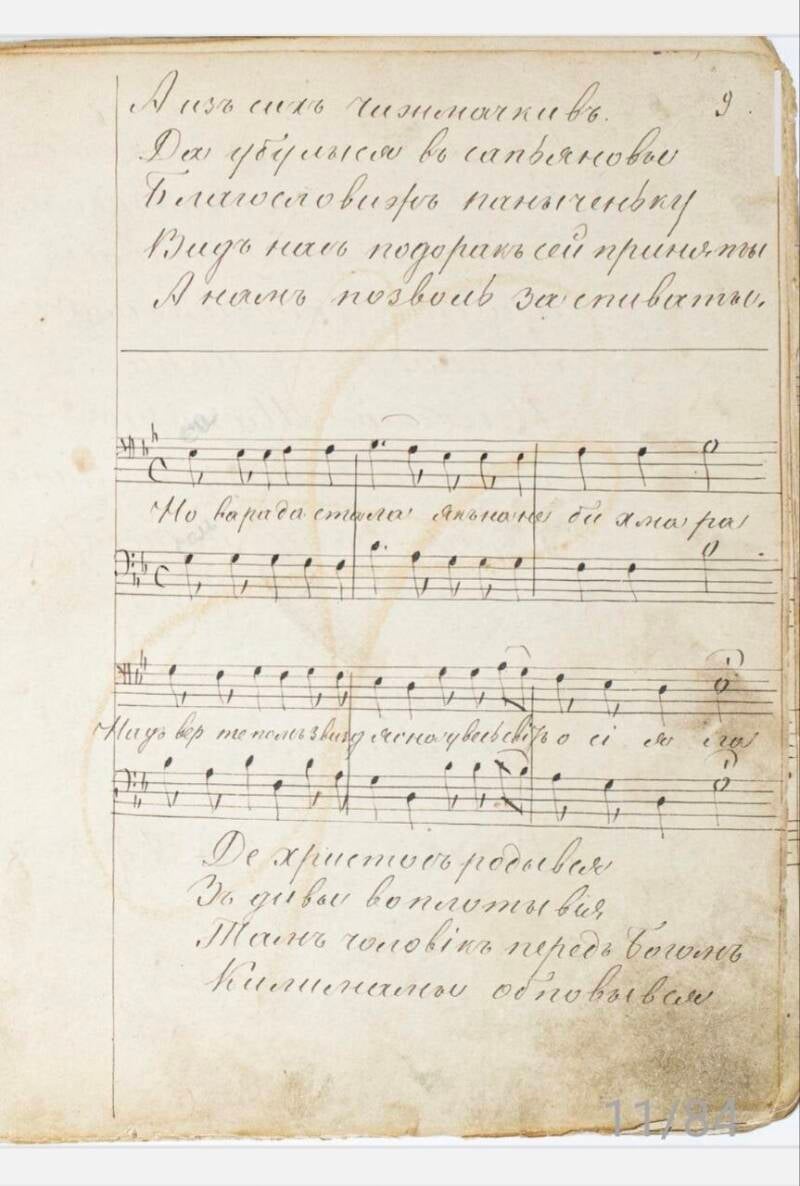
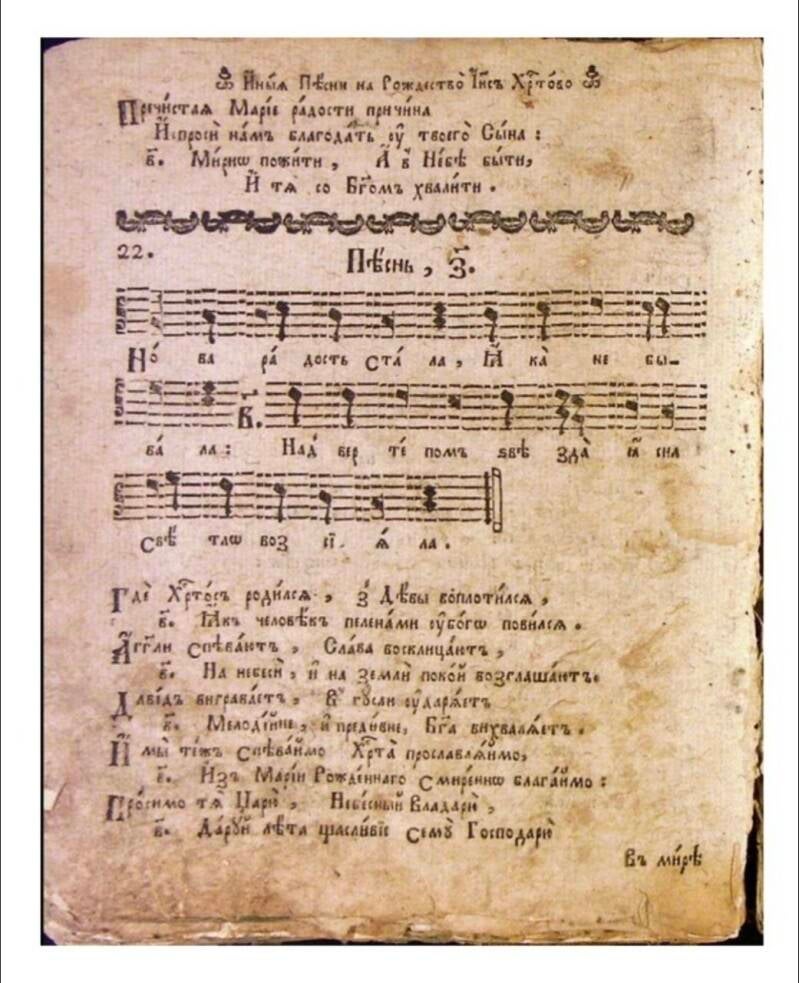
The Sokyryntsi Vertep preserves an extensive musical component, including vocal parts written in historical notation using C-clefs. There was, however, a practical matter to resolve. The historical music includes four-part writing and was originally performed by male voices, while Culbaba Theatre is predominantly a women's ensemble. For our performance, I decided to adapt the four-part texture for three voices and transpose most of the songs to suit the available vocal ranges. Throughout this process, I have tried to preserve the original voice-leading and overall harmony as closely as possible.
During the work on the Vertep, I came across earlier versions of some of the chants used in the performance, including Nova Rada Stala and Ne Plach, Rakhyle, whose histories reach back well before 1770. Comparing different versions opens up possibilities for examining forgotten verses, alternative vocal arrangements and the ways these songs changed over time.
Some of these pieces have continued to develop independently of the Vertep, inspiring arrangements by composers across different generations, including contemporary musicians. There is something wonderful about following a melody through centuries of use and discovering how many different forms it has taken - beautiful example of how intangible cultural heritage continues to live and change.
The historical dramatic text has also been transcribed into modern Ukrainian orthography. Changes in spelling and pronunciation over the centuries have given Culbaba Theatre's performers some unfamiliar language to work with during rehearsals.
For the British audience, I decided to retain the original Ukrainian dialogue and songs, accompanied by English subtitles. The translation needs to remain faithful to the historical text while sounding natural in English and fitting the familiar Nativity story. The verse presents an additional challenge: preserving its rhyme and metre, especially in the songs, where the translated lines should also follow the musical phrasing.
The spoken text has now been translated, and I have been discussing the English wording with native speakers to check how naturally it reads. So far, the results are encouraging, although the songs are still in progress. I hope the translation will eventually make the Vertep more accessible to English-speaking audiences beyond our own production. After the premiere, I would be happy to share this work with British cultural and theatrical organisations interested in the material.
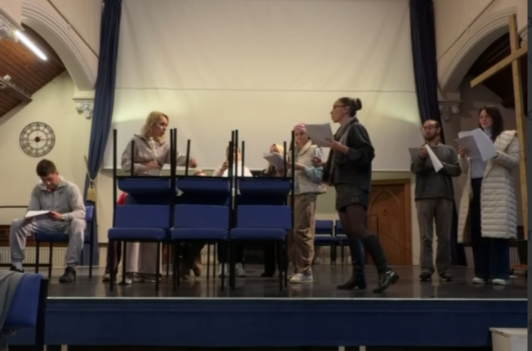

The first public presentation of the reconstruction is scheduled for 13 December 2026, when Culbaba Theatre will perform the Nativity part of the Sokyryntsi Vertep, traditionally known as the Misteria. The historical work also contains a second part, consisting of secular scenes and a larger cast of characters, but we decided to approach the reconstruction in stages.
There are practical reasons for this. The Nativity play alone involves fourteen puppets, the construction of the theatre chest, and extensive work with the historical music, text and English translation. The project is currently funded through personal contributions from myself (Olena Zdielnikova) and Nataliia Demianenko, and developed alongside our full-time work and Culbaba Theatre's regular activities. Preparing the second part separately allows me to continue the research, and for us to develop the production without rushing the process.
The second part also calls for a thoughtful approach to certain characters and scenes that reflect the social attitudes of their time. I have already begun working with this material, considering how to retain its historical character while making appropriate choices for a contemporary performance.
The surviving chest, puppets, manuscripts and historical accounts have provided the basis for this reconstruction. The December performance will be the first opportunity to see how the puppet mechanisms, music and dramatic action work together on stage. What we learn from this production will help us with the reconstruction of the second part, planned for Christmas 2027.
On behalf of Culbaba Theatre, I would like to thank the Museum of Theatre, Music and Cinema Arts of Ukraine for its cooperation and support.
For now, there are still puppets to finish, songs to translate and rehearsals ahead. We look forward to presenting the first part of the Sokyryntsi Vertep in Bexhill this December.
Olena Zdielnikova
The Sokyryntsi Vertep — First Public Presentation
Sunday, 13 December 2026, 2:00 pm
St John's Centre, Bexhill-on-Sea
Tickets: £15 adults | £10 Children under 16s
Presented by Culbaba Theatre CIO.
Project Credits
Artistic Direction, Historical Research, Music and Text Reconstruction, Puppet Design and Making: Olena Zdielnikova
Theatre Construction, Museum Liaison and Project Support: Nataliia Demianenko
Performance and Production Assistance: Culbaba Theatre members and volunteers
With thanks to the Museum of Theatre, Music and Cinema Arts of Ukraine for its cooperation and documentary assistance.
Culbaba Theatre CIO | Registered Charity No. 1218790
Add comment
Comments