
A Ukrainian Christmas Puppet Theatre · Bexhill, 13 December 2026
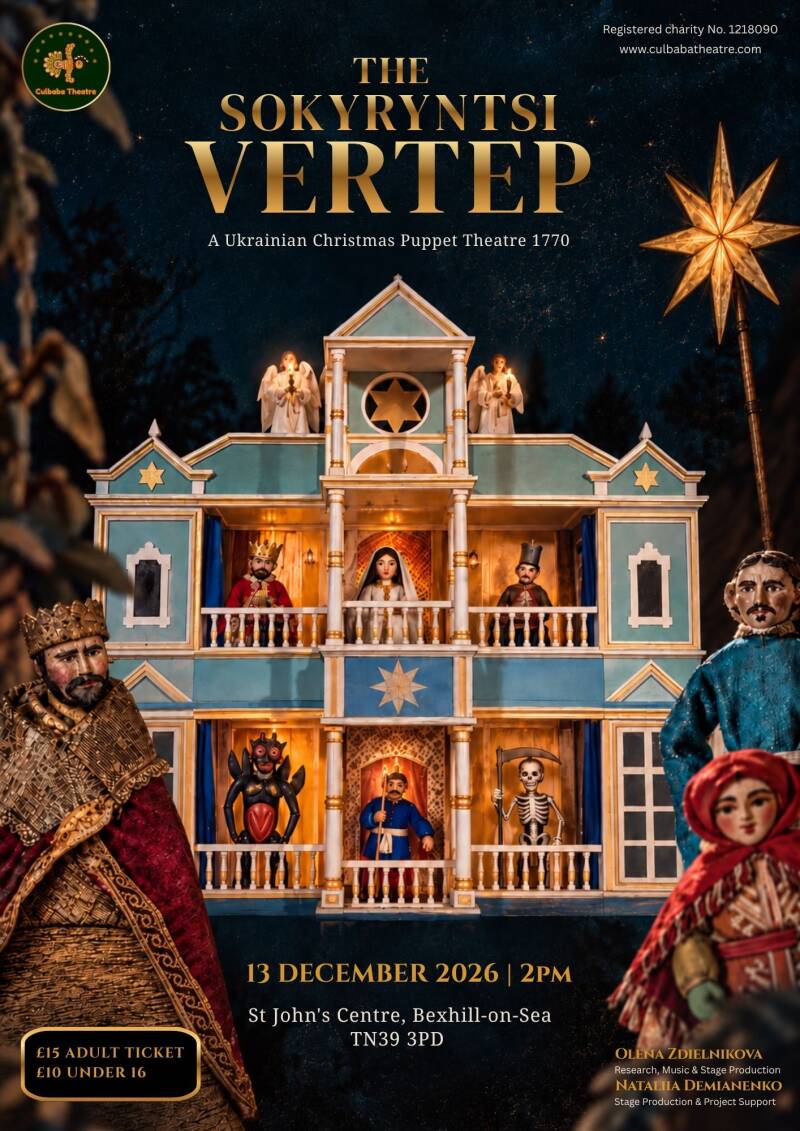
This December, a small two-storey puppet theatre will appear on stage in Bexhill. Its design is based on an eighteenth-century Ukrainian original. Its cast includes angels, shepherds, King Herod, musicians, merchants and devils. Bringing it back to life has involved everything from deciphering historical musical notation and comparing manuscript copies to converting measurements recorded in vershoks into modern centimetres.
This is the Sokyryntsi Vertep, a Ukrainian Christmas puppet theatre dating from 1770, now being recreated by Culbaba Theatre CIO for a special performance on 13 December.
What is a vertep?
A traditional Ukrainian puppet vertep is a portable theatre built on two levels. The upper stage tells the Nativity story: angels announce the birth of Christ, shepherds arrive to pay homage, and King Herod meets his inevitable fate. Downstairs belongs to another world where familiar characters from everyday life argue, bargain, boast, flirt, dance, make music and occasionally get themselves into trouble.
This combination of sacred drama and popular comedy lies at the heart of the vertep tradition. It belongs to a wider European family of Christmas theatres, alongside traditions such as the Polish szopka and the Belarusian batlejka. In Ukraine, however, vertep developed its own distinctive characters, music and theatrical language. By the seventeenth and eighteenth centuries, it had become an established part of Christmas celebrations across the country.
There was never a single official script. Texts travelled with performers, were copied by hand, adapted for different audiences and passed from one generation to the next. As a result, many local versions emerged. The tradition also evolved beyond puppetry: in some regions performers took the roles themselves, creating a live form of vertep that remains popular in Ukraine today.
The Sokyryntsi Vertep
The Sokyryntsi, or Galagan, Vertep is one of the oldest surviving examples of Ukrainian puppet theatre and one of the very few for which enough evidence survives to attempt a historically informed reconstruction.
Its story begins at the Galagan family estate in Sokyryntsi in 1770. According to family records, students from Kyiv arrived there at Christmas and performed a vertep, leaving behind the theatre, its puppets and the script.
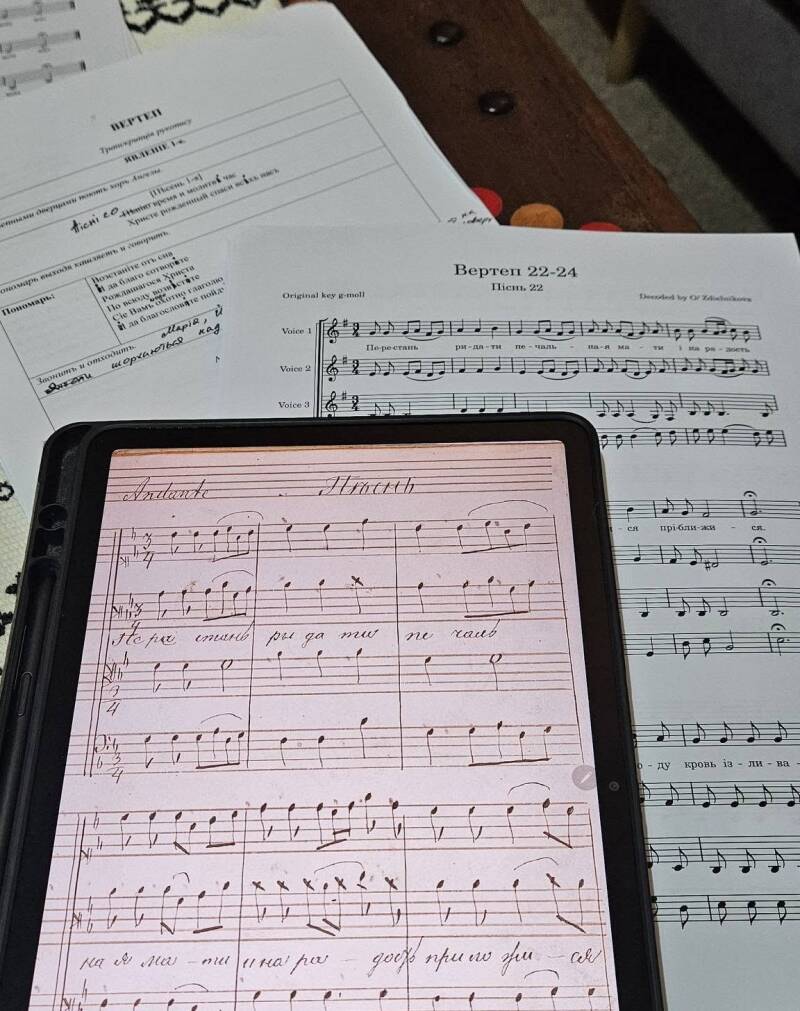
More than two centuries later, an unusual amount of material connected with that theatre can still be studied. The box itself survives, as do some of its original puppets, alongside texts, musical notation, drawings, and written descriptions. However, the original 1770 manuscript has not survived, and the text and music are known only through early nineteenth-century copies. When Yevhen Markovskyi studied the Sokyryntsi Vertep, he compared three versions of its text, so we did as well.
Reconstructing the Sokyryntsi Vertep
“Reconstructing a vertep from 1770 is a challenge in itself. The music was written using C clefs, and some of the metres and harmonic structures can seem unusual to a modern ear at first, but for me that is exactly where the beauty lies.”
— Olena Zdielnikova, Artistic Director.
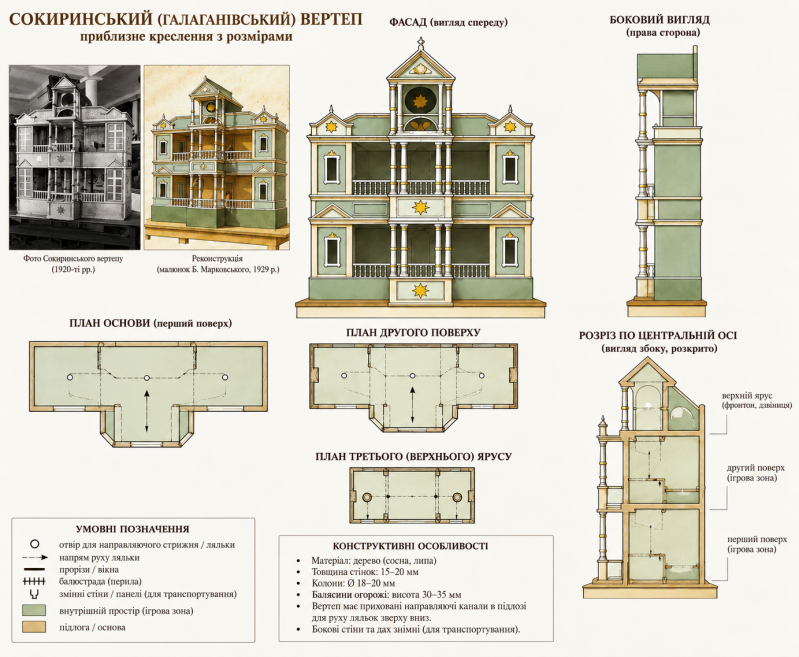
Even though the vertep box itself and some of its puppets have survived, they still leave questions to answer. The drawing supplied by the Galagan family differs in some details from the box that was eventually transferred to the museum, while research sources show that some of the puppets, or elements of their appearance, were replaced over time, and others were lost or renewed.
There is no ready-made construction plan either, although sufficiently detailed descriptions of the dimensions and mechanisms have survived to make reconstruction possible. Those measurements first had to be converted from the old vershok system into modern metric units before Nataliia Demianenko, who is responsible for reconstructing the vertep box, could turn the historical descriptions into a working structure.
The greatest question, however, concerned the second half of the play. The Nativity scenes from the first part ("Misteriia")are still easy for modern audiences to follow. The comic scenes from the second are rooted much more firmly in the social world of the eighteenth century. Their humour, assumptions and stereotypes tell us a great deal about the period that produced them, but they do not always speak easily to a twenty-first-century audience. After transcribing the text, we decided to preserve the Misteriia unchanged, and to keep characters and musical material from the second part while adapting the dialogue to contemporary standards.
This project has often felt less like preparing a production and more like piecing together a theatrical puzzle from scattered fragments preserved across more than two centuries.
The work is far larger than the resources currently available to us. Yet that has not stopped us from attempting to bring a Ukrainian Christmas performance and Vertep Tradition from 1770 back to the stage.
On 13 December, audiences in Bexhill will have the chance to see the result and discover a remarkable piece of Ukrainian cultural history brought to life once again.
Add comment
Comments