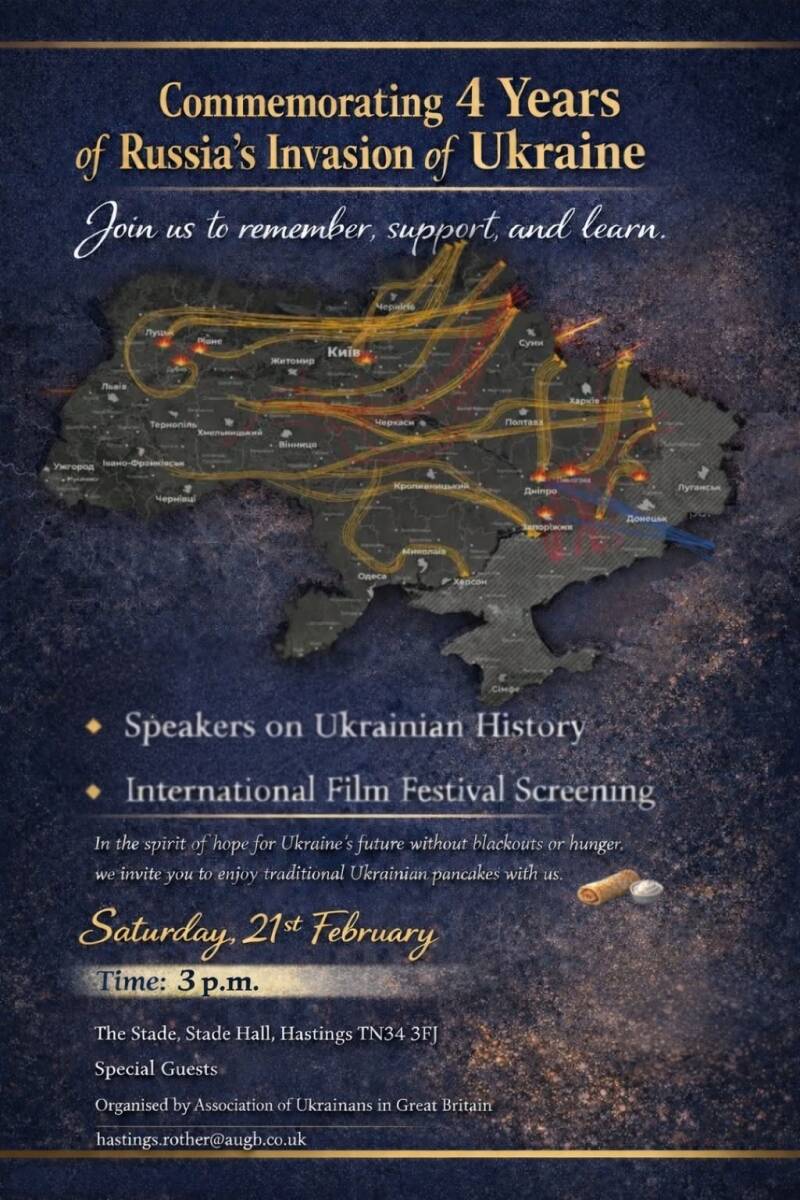


On the fourth anniversary of Russia’s full-scale invasion of Ukraine, an educational event in Hastings brought together historians, researchers, public figures and members of the local community to explore the historical roots of the ongoing war and Ukraine’s long struggle to preserve its identity.
Organised by the Association of Ukrainians in Great Britain Hastings Brunch, the programme examined Ukraine’s history from the medieval period to the present day, highlighting the political, cultural and social forces that have shaped the country and its relationship with Russia over the centuries.
A particularly valuable aspect of the event was the participation of British speakers and researchers who have helped bring Ukrainian history to wider international audiences. Among them were Professor Jeremy Hicks, whose work has contributed significantly to public understanding of the Holodomor, and Samara Pearce, great-granddaughter of photographer Oleksandr Wienerberger, whose photographs remain among the most important visual records of the famine in Soviet Ukraine. The event was also attended by Hastings and Rye MP Helena Dollimore, who reaffirmed her support for Ukraine and highlighted ongoing efforts to assist Ukrainians affected by the war.
Among the speakers was Olena Zdielnikova, Artistic Director of Culbaba Theatre, who presented a cultural and historical overview of Ukraine during the period of the Russian Empire and the rise of the national liberation movement. Drawing on historical sources, the presentation examined restrictions placed on the Ukrainian language, publishing, education and theatre, as well as the ways in which Ukrainian cultural life continued to survive and develop despite official prohibitions.
Particular attention was given to the role of culture in preserving national identity. The presentation explored how Ukrainian theatres, musicians and community groups continued their work despite censorship and political pressure, and how folk songs became a means of preserving historical memory when other forms of expression were restricted. The audience also learned about the Ukrainian Republic Capella led by Oleksandr Koshyts, whose international tours introduced Ukrainian music to audiences across Europe and North America during Ukraine’s struggle for independence.
To illustrate these themes, members of Culbaba Theatre performed the traditional folk song Oi u Poli Zhyto (“Rye in the Field”), a ballad telling the story of a fallen young Cossack. The performance highlighted how the song evolved over time, with different versions reflecting the historical circumstances of the communities that sang it. Like many Ukrainian folk songs, its lyrics were adapted by successive generations, preserving memories of loss, war and resilience through changing political eras.
The programme also included contributions from lawyer Hanna Harnyk, transport systems expert Kostiantyn Babakalov and Khrystyna Mashchenska, head of the local branch of the Association of Ukrainians in Great Britain. Together, the speakers examined topics ranging from medieval Ukrainian statehood and imperial policies to Soviet repression, forced deportations and contemporary Russian aggression.
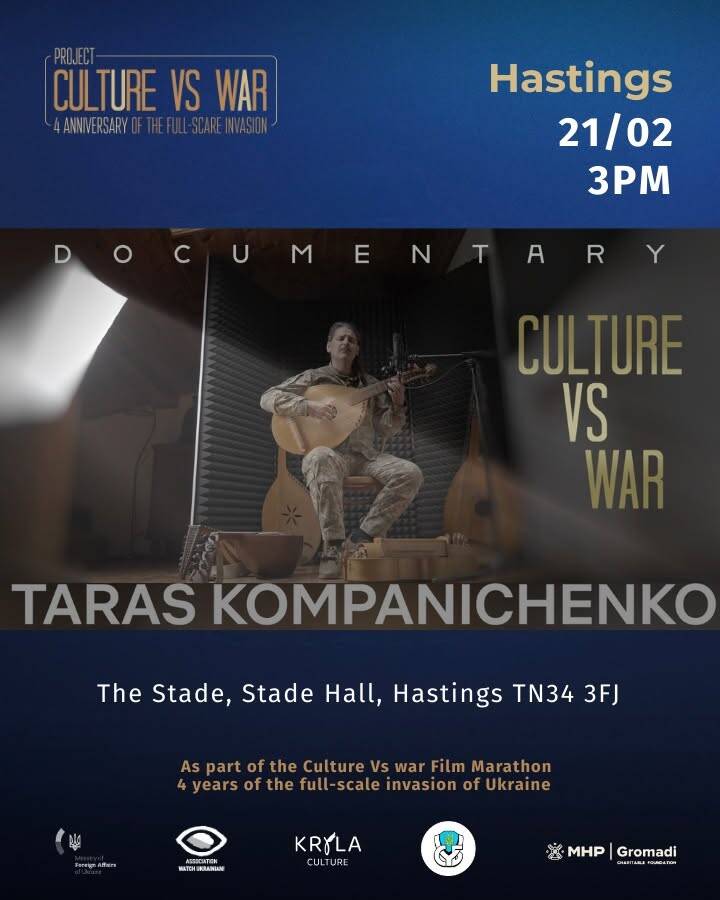
As part of the event, guests also viewed a documentary film from the Culture and War project featuring Ukrainian musician and cultural figure Taras Kompanichenko, followed by discussion and reflection on the role of culture in preserving historical memory during times of conflict.
Culbaba Theatre was pleased to support the event by providing the sound equipment used throughout the programme.
The event concluded with thanks to the British community for its continued support of Ukraine and to members of the Ukrainian diaspora who attended. Educational initiatives such as this help build a deeper understanding of Ukraine’s history and culture, creating opportunities for meaningful dialogue and strengthening connections between communities.
Read the full newspaper coverage of the event
Add comment
Comments